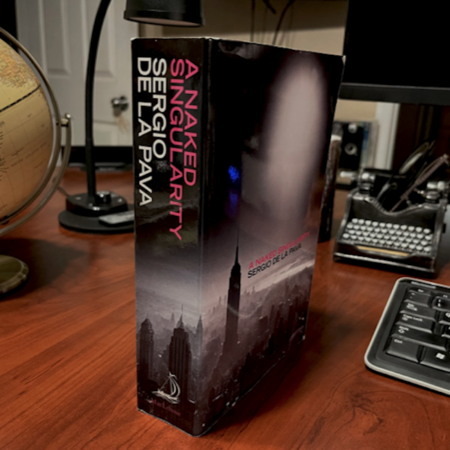

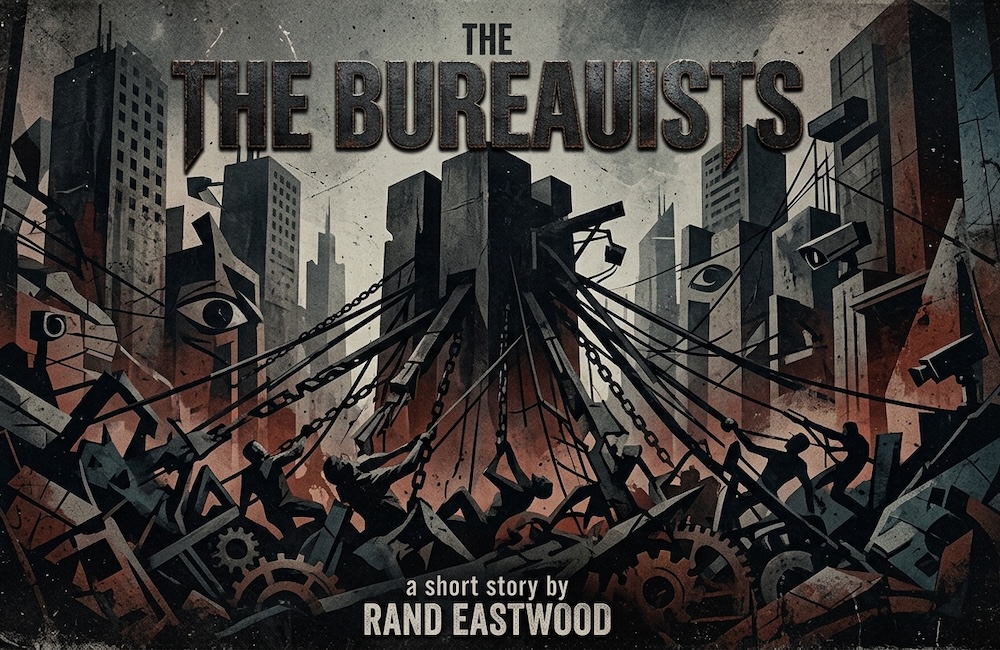
I started this story sometime in 2024, but didn’t get around to finishing it until a year later—even though I already had the whole thing, start to finish, in my head before I began. Just didn’t have the time and/or energy, with so many other projects in the hopper—like finishing my epic novel PRIMEVAL. But now that it’s done and available on Amazon, I finally had the time to sit down and hammer this one out. Enjoy! ~ R

“We got a notice from The Bureau today, by post,” his wife announced to him as he stood in the entryway, briefcase in hand, jacket flung over his shoulder, having just returned home from work. It was late, as usual, the night already setting in. Without turning away from her, he closed the door on the darkness behind him.
”The Bureau?” he asked, a sinking feeling in his gut. “That can’t be good. What department?”
But he suspected he already knew.
”Family Planning,” she said with a sigh.
”You gotta be shittin’ me.”
•
Walking toward her across the living room, he abandoned his jacket and briefcase on the narrow entry table set to the right, being careful not to bump the plain red telephone that hung on the wall above.
She was leaning in the doorway to the kitchen, arms crossed, the crisply creased white paper dangling in one hand, half hidden behind her arm. As he approached, she turned and entered the kitchen, running a hand through her hair in frustration as she tossed the notice on the kitchen table.
“They’re predicting a shortage of laborers again,” she said, turning to him as he entered the kitchen behind her. “They’ve issued a decree. We have to have another child. A boy.”
“Jesus, we’re barely making it with the two kids we have—”
“John, keep your voice down,” she hissed, cutting him off abruptly.
Placing one hand gently on her waist, he moved them both back away from the table, where they knew there was a hidden camera—probably in the chandelier above—and at least one microphone (the microphones were the worst—they were everywhere). They moved quietly together, by habit, almost a romantic dance, past the big stainless-steel sink and toward the refrigerator, which jutted outward about eighteen inches, the cabinets and counter continuing beyond. They stepped around the fridge into the small recess it formed on the other side, pressing close together. This was the one spot in the entire house that they believed was safe from both the spying eyes and listening ears of The Bureau, based on what they’d gathered from all the notices, warnings, citations, and discredits they’d received over the years.
To their outrage, they’d even received a warning when they’d casually complained about The Bureau to each other one morning, muttering under their breaths—in their bathroom!:
“You know, this isn’t what we voted for,” she had whispered to him in the mirror. “I mean, they promised us so much…”
“When have you ever known politicians to keep their promises?” he whispered back matter-of-factly.
“You have a point,” she admitted.
He shrugged. “Well, there’s nothing we can do about it now. The referendum abolishing all future elections was passed overwhelmingly. The people have spoken…enough of them, anyway.”
“But how could so many people want THIS?”
“Easy: because most people don’t study history.”
And that was all they said—but it was enough to receive a warning from The Bureau within the week.
So they started testing different covert areas around the house, quietly saying trivial things that would likely warrant a warning but no more, and to the best of their knowledge, none of the infractions they’d been assessed during their experiments had stemmed from any of their actions or conversations while standing in this exact, tiny recess beside the fridge. So they decided it was safe.
Once they had squeezed into the covert spot, he lowered his voice. “Why you? Us?”
“They held a lottery today,” she said in a near whisper. “The names of all the women of child-bearing age were entered, and they randomly selected twenty percent—or so they say it was random, who knows with The Bureau? Anyway, mine was supposedly one of the names drawn. I’m to report to the fertility clinic tomorrow morning for implantation.”
He slid his arms around her. “Or, we could do it the old-fashioned way,” he purred into her ear. “Whadaya say, Becks?”
“You know that’s forbidden!” she said, pushing his arms off of her.
“We could apply for a waiver,” he said, shrugging. “No holidays coming up, should be plenty available.”
“Are you insane?” she hissed again, barely able to maintain her whisper. “Do you have any idea what that costs?” It would take at least a month of your credits…there’s no way we could afford that!”
He stopped and took a deep breath, peering at the cabinet above them, as if contemplating something. Then back to her:
“We could pay cash,” he muttered quietly. “Rumor has it, they give a discount for cash…”
“Cash?” she whispered, staring up at him, incredulous. “In case you don’t remember, The Bureau outlawed cash last year. Only bureau agents are allowed to use cash now—it’s illegal for the rest of us to even own it!”
“But they also allowed a grace period, to exchange any cash for credits, or to pay any fees or fines…eighteen months, as I recall.”
She shook her head. “Where the hell would we get cash, anyway?” she asked, perplexed. “You only get paid in credits—and very little at that.”
With that, he leaned back and peered around the refrigerator, through the kitchen doorway at the end of the darkened hall. The kids’ bedroom was down at the corner, before the hall turned to the left and ended at their master bedroom.
He turned back to her. “The boys?” he whispered.
“In bed,” she confirmed. “At least an hour. I pulled the door to; it’s not quite closed, but they shouldn’t be able to hear us from there. Probably asleep by now anyway.”
He nodded in understanding. Then again, he looked at the cabinet above them. Then he glanced around the kitchen, shuffling his feet slightly, adjusting his position in the recess behind the refrigerator, making sure he was out of range, out of view. Reaching up, he opened the very top cabinet, which was loaded front to back with canned goods, mostly soup. Reaching still further, up to the top shelf, he began shoving the cans around—
“—what are you doing?” she asked, frowning.
“Shhhh…” he whispered, one finger to his lips while the other continued to rummage among the cans in the cabinet above. Finally, he plucked one out from the back somewhere, and lowered it gently, quietly, to the countertop, keeping it tucked in close to the fridge.
Looking down, she saw that the top of the can was roughly cut out, apparently opened using a hand-held can opener. And instead of containing soup, a fat roll of Bureau notes was stuffed inside.
She gasped, then clenched her hands over her mouth.
They both looked around again, hoping to remain undetected, then back to each other, and she lowered her hands.
“Where the hell did you get that? If they find it—”
“They’re not gonna find it,” he assured her. “If they haven’t found it by now…hell, you haven’t even found it, and it’s been up there for months.”
“MONTHS?” she almost hollered, managing a raspy whisper instead, her eyes wide and full of outrage.
Hanging his head and releasing a long sigh, he looked back up at her and nodded in affirmation.
Hand to her mouth, she looked away, trying to absorb this shocking news. She again ran her hand through her hair, then turned back to him, eyes pleading.
“But where did you get it? How?”
He looked away and signed again. Then back.
“The Underground,” he whispered, now nearly inaudible. “I was gonna tell you, when the time was right—”
“The Underground?!” she screeched under her breath, eyes so distraught they began to water. “Are you trying to get us all killed?”
He proceeded to explain to her how, since he works in civil engineering, he has access to all sorts of files—building blueprints, street plans, sewer system, power grid, you name it—all of which the Underground would pay handsomely for, as they used them in planning their covert operations.
And how, when they’d first approached him, he said no way, The Bureau tracks all of his computer logins, the files he accesses, anything he prints. But then they explained to him the work-around: they would supply him with a ball-point pen that contained a tiny hidden camera; clipped into his shirt pocket, he could simply reach up and click it and it would take a picture of whatever he had up on his screen. It held a dozen shots.
Then they offered him so much money that he couldn’t possibly say no.
And it was easy: he’d simply made it a habit to stay at work after hours—when most everyone else had gone home—under the guise of “doing homework.” Sitting alone at his desk, he’d simply bring up whatever plans the Underground had asked for on-screen, pretend to be organizing them into new file folders, while casually clicking the pen in his pocket as he studied them, almost like a nervous twitch, until it was full, he had his dozen shots.
Then, when he took the subway home, there was always somebody sitting on the bench at his entry point, dressed in hat and overcoat, with a replacement pen sitting on the bench beside him. He’d sit down next to the old gent, and while waiting for the train, simply place his used pen on the bench next to the new one and then swap them, picking up the replacement, one quick motion nobody noticed, as he stood to board his train. The stranger would then pick up the abandoned pen, stand, and walk away.
He never knew where the man went.
And each time, upon arriving home, when he unscrewed the pen—while standing behind the fridge, of course—he retrieved two papers rolled together: a §100 Bureau Note—which he rolled with the others in the soup can, then re-stashed it up in the back of the top cabinet—and a tiny note listing the next dozen documents to be photographed. This he memorized, then burned the paper in the flames of the gas stove, his back to the chandelier, while fixing himself a late dinner.
“So this is why you’ve been so late coming home,” she muttered angrily.
He nodded.
Sighing heavily, she lowered her head and put one hand to her forehead, her eyes now hidden behind her dangling hair.
“You know they execute anyone caught working with the underground, don’t you?” she whispered, still in disbelief of everything he’d just told her.
He nodded again. “Look, we need the money. And anything that takes a stab at The Bureau, I’m—”
“Have you heard the rumors?” she interrupted, returning her eyes to his, glaring now. “Word is, they’re harvesting dissidents now. There’s an organ shortage at the Bureau hospital. So not just rehabilitation camp, or hard labor prison, not even just execution—but harvested. Do you want that for yourself? Or how about me? The boys?”
Just then, they heard a clicking sound in the living room.
Like a phone being quietly—covertly?—hung back up.
They both immediately stopped speaking and silently listened, looking at each other with alarm. Moving quickly, John set the can on the counter behind her, stepped around the fridge, and looked out the kitchen door.
Their oldest son, Jason, was standing in front of the red phone, looking at it, his hands clasped together at this chest.
“What have you done?” he asked the boy loudly, walking briskly toward his son.
Jason turned and looked up at his father, a look of concern on his face.
“I was thirsty and came to the kitchen to get a glass of water, but when I got to the sink I heard you talking behind the fridge,” he explained.
Then he pointed up at the Bureau Pledge framed above the phone, reciting aloud:
“Any statements, writings, or deeds of any kind that in any way go against herein posted Bureau standards or by their interpretation imply anything less than the utmost respect and honor for, and cooperation with, the Bureau and/or any agent thereof, shall be reported immediately to the Bureau Informant Agency using the red direct-line phone which is installed, along with the Bureau Pledge, in a conspicuous location in all homes.”
Turning back to his dad, the boy continued: “It’s in the pledge, that we all read aloud together every morning, right?”
The man’s eyes widened, he simply could not believe what his son had done. Kneeling to his boy, he grabbed him roughly by the shoulders, but tried to remain calm.
“Yes, son, it is, but I thought you understood that we don’t always—”
“John, shut up!” Becky hissed from the kitchen door behind him.
He snapped back at her, surprised.
She mouthed silently at him: You’ll only make it worse.
Knowing she was right, he didn’t continue with his explanation to his son. And he also knew he didn’t have much time. He stood, turned, and hurried quietly into the kitchen, snatched the soup can full of Bureau Notes up, and began stashing it back in the upper cabinet behind the others.
Finished, he returned to the other room to find Becky consoling their son, who was now crying.
Then, a loud knock on the door. But before they could respond, they heard the sound of the master key being thrust in from the other side, and the door quickly flung open.
The Inspector strolled in, flanked by four officers pointing small submachine guns, two to a side. He wore a long gray trench coat, black leather gloves, and a black fedora-style hat.
As John raised his hands in surrender, the Inspector said simply, “Arrest him.”
“No!” Becky pleaded, and began sobbing.
As they cuffed him and led him out the door, the Inspector turned to the boy.
“You did the right thing, son. The Bureau will be proud of you. And you should be proud of yourself, too.”
“Thank you, sir,” the boy muttered, looking down at the floor, unsure.
Weeping, Becky sniffed, wiped her eyes, and looked up at the Officer. “Sir, I was summoned by Family Planning, and am to report for implantation tomorrow. But perhaps under the circumstances, I could get a deferment? Could you—”
“No need,” he said, turning from the boy to her. “We have a fresh crop of rehabs being released from re-education camp on Monday. Good workers, very cooperative—at least now. You’ll be assigned an appropriate husband.”
She barely squeezed out a whispered “Thank you, sir,” before she continued weeping, faced buried in her hands.
Then, turning back to the boy, the officer said: “School starts soon. What grade will you be in?”
Without looking up: “Seventh.”
“First year of middle-school, eh? Well, that’s perfect!”
The boy finally looked from the floor back up at him, perplexed.
“I’ll make some calls, get you into the Bureau officer training school instead of civilian school. What you’ve done today shows that you are definitely officer material!”
With that, he clapped the boy on the back of the shoulder. Then, looking over the boy, he saw Tyler, his younger brother, standing in his pajamas in the bedroom door at the end of the hall, looking frightened.
“You should be proud of your big brother,” the Inspector called down the hallway. “He’ll be an officer one day. You should try to be like him, follow in his footsteps—which I’d say are pretty big shoes to fill.”
With that he winked.
“Yes sir,” the boy said feebly.
The inspector turned back to Jason, who said:
“I thought officer training school was just for officer’s kids…that kids like us had to stay in regular school, learn the trades…like our parents.”
“Officer training school accepts anyone who aptly demonstrates their commitment to The Bureau, and its policies—which of course, are created in the best interest of everyone, not just some. And I’d say your actions today aptly demonstrated that. Unlike those of your father—”
—with that he looked up sternly at her, then back to the boy—
“—I say the word, and you’re in.”
The boy’s face brightened, and he smiled through his teary eyes.
“Gee, thanks!”
The inspector turned and approached Becky. She was still looking at the floor, sobbing, arms crossed around her. Lifting one hand, he placed his fingertips under her chin, and lifted her face to his.
“You’re in luck…I’m in a generous mood,” he said, smiling.
She just looked at him, eyes wet, tears streaming down her face, and waited.
As if to check on his assistants, he turned and swept the room with his eyes—all empty, the guards had escorted John outside—then back to her.
“You get me that money, and I’ll affirm that you knew nothing about your husband’s illegal activities in my report.”
Her eyes widened. “But I didn’t—”
He immediately lifted his other hand and placed one index finger to her lips, silencing her, and moved his face close to hers, the brim of his hat nearly bumping her forehead.
“Shhhhhhh….” he hissed.
Again, she just waited, her terrified eyes locked with his.
“The money, and I leave you and your boys be,” he said in a near whisper.
She nodded in understanding, and he lowered his hands.
“That’s a good girl,” he commended softly as she turned and went into the kitchen.
Once behind the fridge, she opened the topmost cabinet and began rummaging through the cans.
“This is all of it?” he asked as she handed the can over.
“Yes sir.”
He stuck one black-gloved finger in, dividing the notes, roughly ascertaining the amount.
“It better be,” he said in a warning tone. “I’ll be watching.”
“That’s all of it,” she said. “All that I know of, anyway.”
He nodded, shoved the can into a large pocket in his coat, then turned and walked toward the still-open front door. At the threshold, he stopped and turned back to her.
“You’ll report to the fertility clinic as scheduled. And you’ll be contacted when your new husband has been vetted.”
She just nodded silently, a single tear running down her cheek.
Again the Inspector looked at the boy, who was now clutching his sobbing mother’s arm, fighting tears himself.
“No worries…you did good, son. You’ll be hearing from the officer training school soon.”
Like his mother, the boy also just nodded silently, still unsure of what he had done.
With that the man turned and strutted out, closing the door gruffly behind him.
The Bureauists Copyright © Rand Eastwood | Eastwood Innovations, LLC | Woodlands Press | All Rights Reserved
Reminder: For anyone who may be interested, I’ve published more of my fiction, for free reading, under the category My Fiction:





| Rand Eastwood |
Rand Eastwood is an author, blogger, artist & craftsman living in Las Vegas, NV. Certified in both nutrition & ancestral health, he is a healthy nutrition & lifestyle advocate. Under Eastwood Innovations, LLC he operates this author website, OÚSIA Magazine, Woodlands Press, Lifeology Store, Compass Bookstore, EVOLVE: Toward Autarchy on Substack, Eastwood Poolworx (under development) and Eastwood Studios (under development). His dark fiction collection Rolling The Bones, epic novel PRIMEVAL, and other books are available from Amazon and Compass Bookstore, and much of his short fiction is available to read/download here in the My Books & Fiction Category. For updates, subscribe to this blog and/or follow his Amazon author page. | |
If you have enjoyed any of the content I've published here, please consider subscribing to my author website to receive future updates: simply enter your email into the form below, or just use this simple quick sign-up form. Thanks! ~ R
captivating fiction, free downloadable
ebooks, or new book releases!
Subscribe Today:
Featured Articles • My Books & Fiction
Arts, Crafts, & Projects
Today's Cognition • Free Ebooks • Blog
Typology Mugs • Lifeology Store
Free Ebook Library • Compass Bookstore
EVOLVE: Toward Autarchy (Substack)
Check Out My Books on Amazon: | ||

| 
| 
|
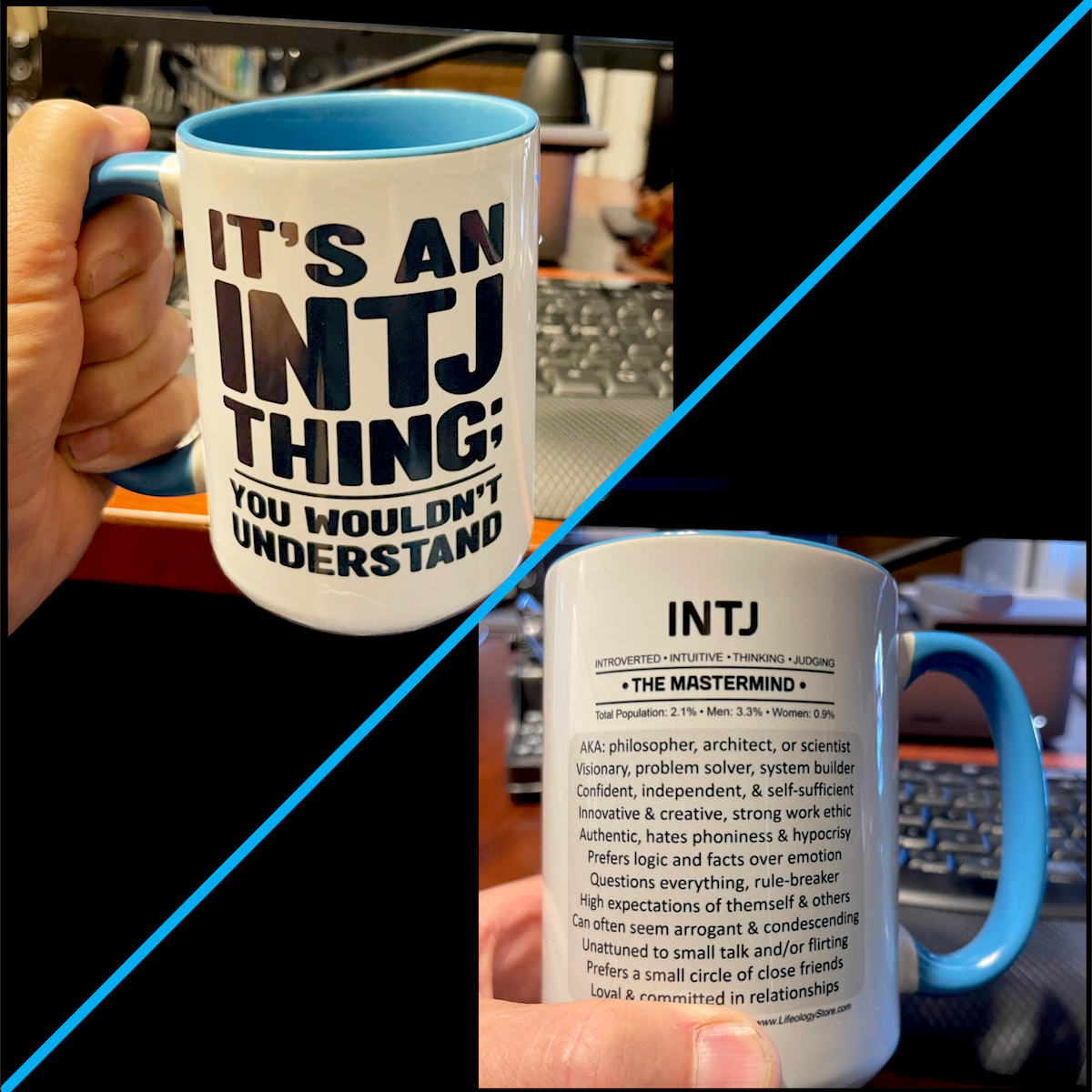
Unique Typology Mugs Exclusively From Lifeology Store: | ||
Have you learned your unique personality type? Then you deserve a mug that's as unique as you are! | ||

| 
| 
|
All 16 profiles are available in a variety of beautiful colors—and even LH or RH orientation! Visit Lifeology Store & get your unique Typology mug today! | ||

| ||