

This past summer, over the short span of a month or two, I had no less than five random people enter my life, all of whom encouraged me, in one way or another, to pursue my goals and ambitions—encouragement which, at this juncture in my life, was very much needed—and I had to wonder whether this string of similar incidents was some kind of sign, or divinity, or something of that nature.
Then one day out on the route, while contemplating this, I told my co-worker about it, and wondered out loud if it was merely coincidence, or was it “divine intervention” or a “sign from the Universe”, etc….?
He responded, in his usual negative manner: “Well, I don’t believe in any of that nonsense.”
Disheartened, I dropped it.
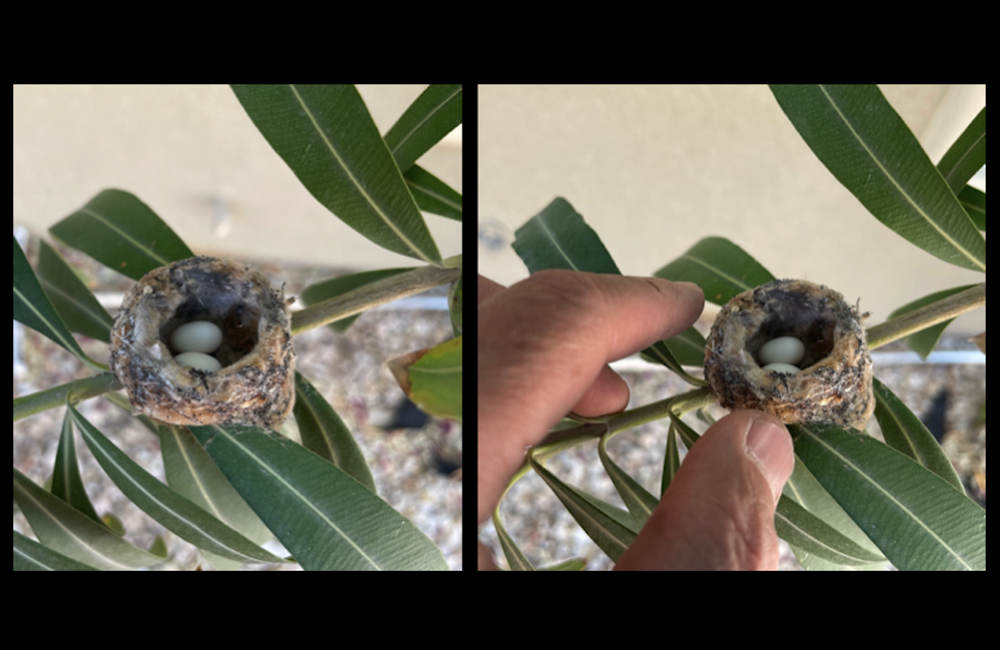
Later that day I stumbled across a little hummingbird nest in a small tree on the job site, along with two tiny little eggs, pictured at the top of this post (I took the second pic with my fingers in the shot for size reference). I was absolutely enthralled!
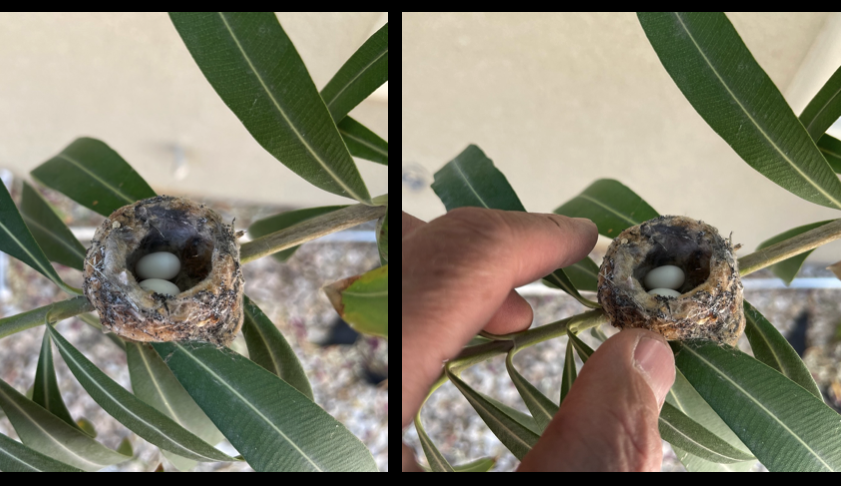
So I called out to him: “I know you “don’t believe in any of this nonsense”, but you might wanna come look at this.”
He came over and looked, and, without a word and looking quite unimpressed (as usual), he trudged silently away and returned to his work.
Then I suddenly realized: I had just inadvertently—and perhaps for the first time consciously—expressed my conceptualization of God.
See, I’ve never conceptualized God as a deity; instead, I’ve come to conceptualize God as Truth, God as Love, God as Action, God as a verb, etc.
Conveying this same conceptualization, in his book Truth Is God, Gandhi states in chapter 5 entitled God is Love:
“Scientists tell us that without the presence of the cohesive force amongst the atoms that comprise this globe of ours, it would crumble to pieces and we cease to exist; and even as there is cohesive force in blind matter, so must there be in all things animate and the name for that cohesive force among animate beings is Love. We notice it between father and son, between brother and sister, friend and friend. But we have to learn to use that force among all that lives, and in the use of it consists our knowledge of God.”
And, I also discovered this description in Charles Fillmore‘s lesson Spiritual Substance, the Fundamental Basis of the Universe, which I think helps convey my abstract thinking on the subject:
“God is substance, not matter, because matter is formed, while God is the formless. God substance lies back of matter and form. It is the basis of all form yet does not enter into any form as a finality. Substance cannot be seen, touched, tasted, or smelled, yet it is more substantial than matter, for it is the only substantiality in the universe. Its nature is to “sub-stand” or “stand under” or behind matter as its support and only reality.”
And even more recently, I read this quote from Father Richard Rohr in his book The Universal Christ:
“Everything visible, without exception, is the outpouring of God. What else could it really be? “Christ” is a word for the Primordial Template (“Logos”) through whom “all things came into being, and not one thing had its being except through him” (John 1:3).”
Anyway, perhaps St. Augustine conceptualized it up well:
“If you comprehend it, it is not God.”
And finally, I think the following passage from Deepak Chopra, in his book The Future of God, aptly sums up what I felt at that moment when I discovered the hummingbird nest and eggs:
“When there is enough consciousness, God appears. You will know this as surely as you know that you have thoughts, feelings, and sensations. ‘This is God’ will cross your mind as easily as ‘This is a rose’ [or, say, hummingbird eggs]. The presence of God will be as palpable as a heartbeat.”
And:
“God is not a person but a totality of nature.”
As well as the salient words of Albert Einstein:
“To sense that behind anything that can be experienced there is a something that our mind cannot grasp and whose beauty and sublimity reaches us only indirectly and as a feeble reflection, this is religiousness. In this sense I am religious.”
Conclusion
I don’t conceptualize God as a deity—especially with human traits—so discovering an acceptable (and, frankly, credible) conceptualization of God has been a lifelong quest, and I am increasingly coming to believe that God is nature, or life, or consciousness; or perhaps that God is Truth (or conversely, Truth is God)—just as God is a verb, and true religion is found in living and doing, and in self-mastery, and in espousing non-violence. And dovetailing with my quest of seeking, discovering, assimilating, and disseminating Truth [God] is action based on Truth and the anticipated and inevitable consequences thereof—i.e., cause and effect.
But all that being said, whenever I see or experience as wonderful and marvelous as this little hummingbird nest and tiny eggs, I can’t help but feel the presence of God—even though I can’t adequately explain it.
Related Articles




| Rand Eastwood |
Rand Eastwood is an author, blogger, artist & craftsman living in Las Vegas, NV. Certified in both nutrition & ancestral health, he is a healthy nutrition & lifestyle advocate. Under Eastwood Innovations, LLC he operates this author website, OÚSIA Magazine, Woodlands Press, Lifeology Store, Compass Bookstore, EVOLVE: Toward Autarchy on Substack, Eastwood Poolworx (under development) and Eastwood Studios (under development). His dark fiction collection Rolling The Bones, epic novel PRIMEVAL, and other books are available from Amazon and Compass Bookstore, and much of his short fiction is available to read/download here in the My Books & Fiction Category. For updates, subscribe to this blog and/or follow his Amazon author page. | |
If you have enjoyed any of the content I've published here, please consider subscribing to my author website to receive future updates: simply enter your email into the form below, or just use this simple quick sign-up form. Thanks! ~ R
captivating fiction, free downloadable
ebooks, or new book releases!
Subscribe Today:
Featured Articles • My Books & Fiction
Arts, Crafts, & Projects
Today's Cognition • Free Ebooks • Blog
Typology Mugs • Lifeology Store
Free Ebook Library • Compass Bookstore
EVOLVE: Toward Autarchy (Substack)
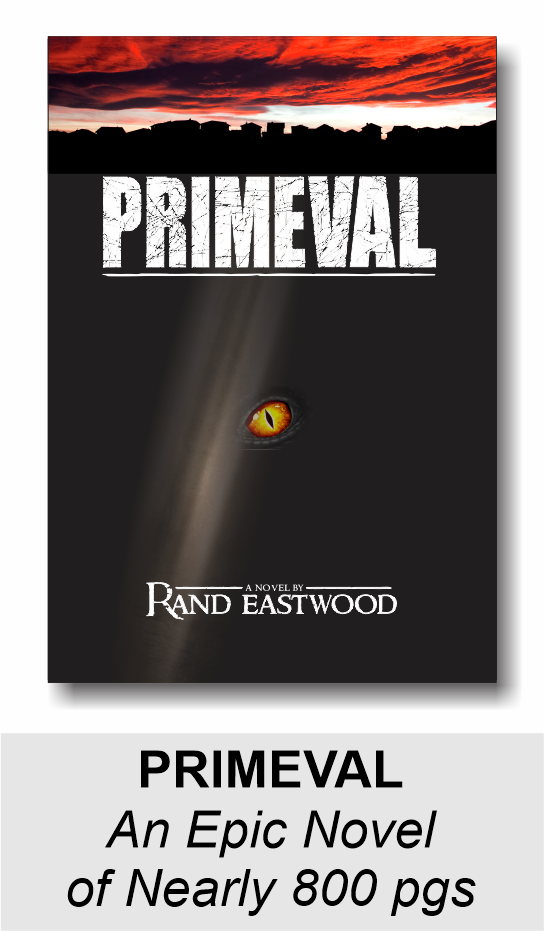
Check Out My Books on Amazon: | ||
| 
| 
|
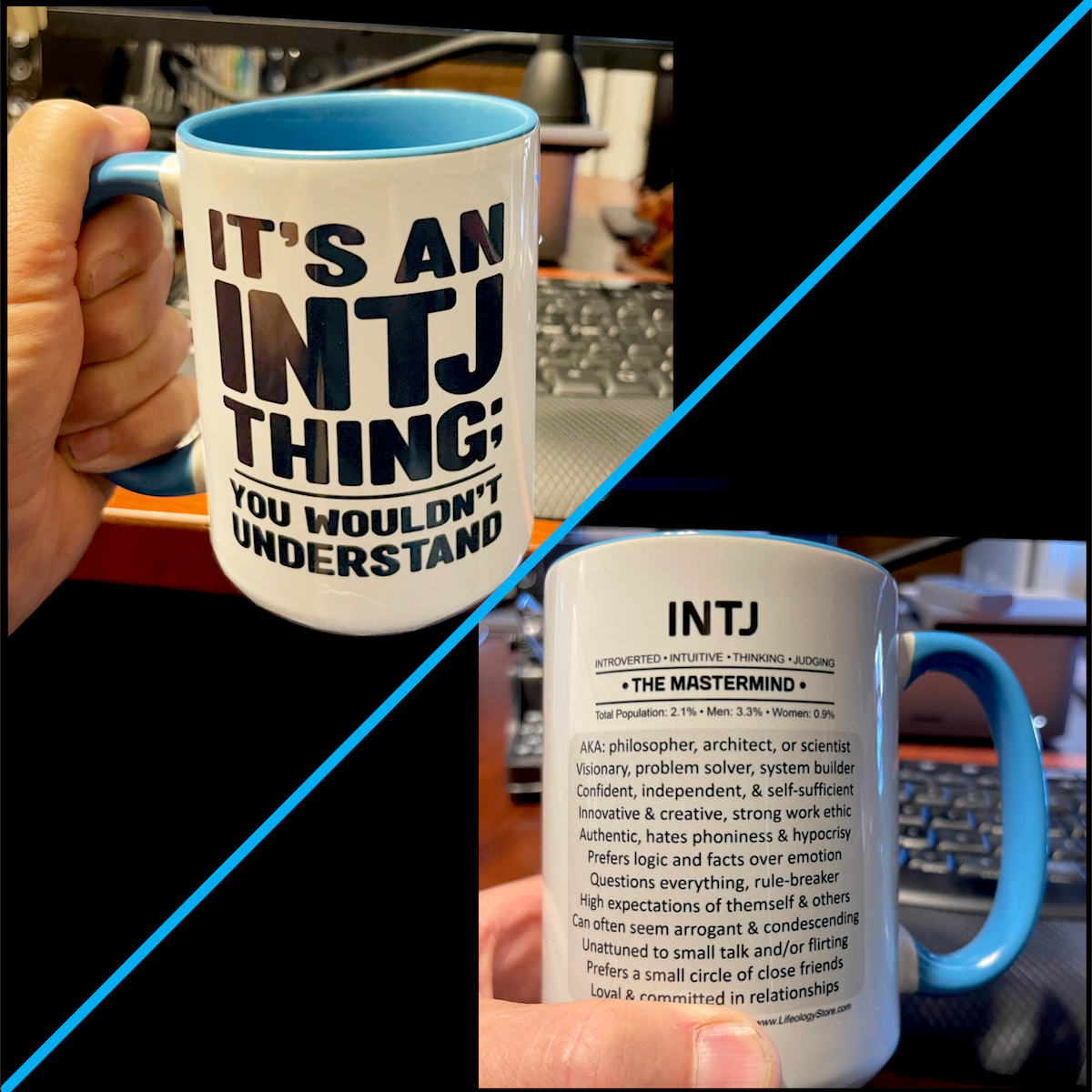
Unique Typology Mugs Exclusively From Lifeology Store: | ||
Have you learned your unique personality type? Then you deserve a mug that's as unique as you are! | ||

| 
| 
|
All 16 profiles are available in a variety of beautiful colors—and even LH or RH orientation! Visit Lifeology Store & get your unique Typology mug today! | ||

| ||